Beyond the Show Ring: The County Fair's High-Stakes Reinvention
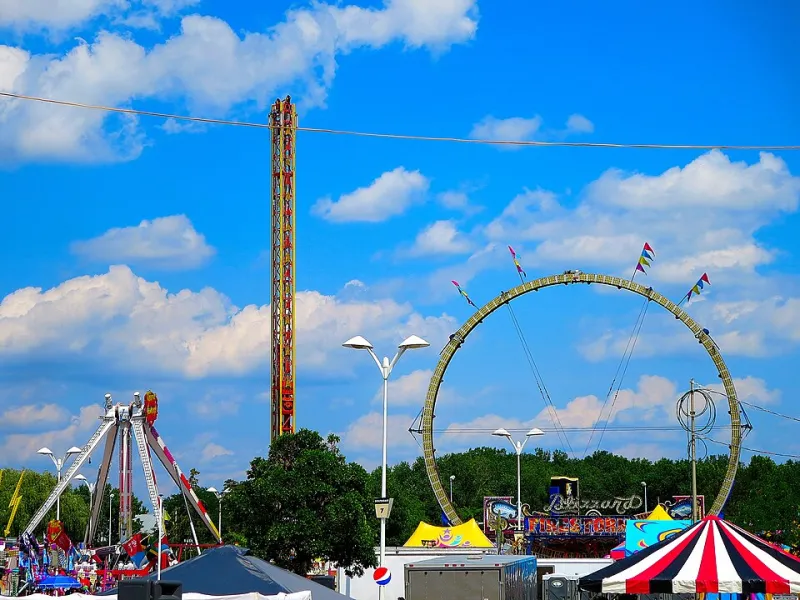
Photo: Corey Coyle, CC BY 3.0, via Wikimedia Commons
The grandstand still fills for the demolition derby. The 4-H livestock barns still smell the same. But walk the grounds of a modern county fair and you'll pass a drone demonstration tent, a broadband access booth, and a queue of bidders refreshing an online auction platform on their phones.
America's county and state fairs—some predating statehood itself—are quietly reinventing what they are. The transformation says as much about the future of rural America as any yield report or farm bill.
From One Week to Twelve Months
The traditional fair model is brutally seasonal: eleven months of maintenance costs, seven days of revenue. Fair boards across the Midwest and Plains have begun attacking that math directly.
In Iowa, Indiana, and Ohio, fairground facilities now host winter farm shows, seed dealer meetings, wedding receptions, and equipment auctions. Some have added RV campgrounds that generate revenue from spring through fall. The economics are straightforward: a fairground is expensive infrastructure, and infrastructure that idles ten months a year is a liability.
The most forward-thinking boards have gone further, positioning fairgrounds as year-round agritourism incubators—hosting farm-to-table dinners, harvest festivals, and educational programming that builds the audience base fair week depends on.
The Tech Expo Arrives at the Midway
Perhaps the most visible shift is the arrival of the agtech showcase. What began as a few dealer booths has matured into dedicated innovation pavilions at major state fairs, where precision ag startups demo autonomous sprayers, soil sensors, and farm management software to an audience of working operators.
The logic is compelling. A farmer at the fair is already in a purchasing mindset, surrounded by equipment displays and fellow producers. For startups that can't afford the National Farm Machinery Show, the county fair offers something better: unhurried conversations with the exact customers they need.
Several fairs have formalized the trend with pitch competitions, connecting rural entrepreneurs with investors—a development that would have seemed implausible at a fairground a decade ago.
The Auction Goes Digital
Livestock auctions, the traditional heart of the junior fair program, are being transformed by online bidding platforms. Hybrid auctions—physical rings streamed to remote bidders—have expanded buyer pools dramatically. A market lamb project in rural Kansas can now attract bids from supporters two states away, including urban buyers with no connection to the community beyond a desire to support youth agriculture.
The financial results have been striking in some jurisdictions, with premium prices on junior livestock projects rising substantially where online bidding has taken hold. Fair boards report that digital buyers often become recurring donors, sponsors, and—critically—visitors.
What Fair Boards Can Learn from the Visitor Economy
Farms that have built successful agritourism operations—the corn mazes, u-pick orchards, and on-farm dinner series profiled widely in recent years—learned hard lessons that fair boards are now applying:
- Sell the experience, not just the exhibit. Static displays lose to interactive demonstrations every time.
- Build the mailing list. Every ticket scanned is a marketing asset for next year and for off-season events.
- Price for the whole family. Gate revenue matters less than total visitor spending across food, rides, and merchandise.
- Partner with local businesses. The fair that drives traffic to Main Street earns political support that lasts longer than any board term.
What the Changes Reveal
The fair's evolution mirrors the evolution of rural America itself. The audience is no longer exclusively agricultural; it includes commuters, remote workers, and urban day-trippers curious about where food comes from. The fair that serves only its traditional base shrinks with that base. The fair that becomes a bridge—between farm and town, tradition and technology—grows a new one.
The pie contest isn't going anywhere. Neither, increasingly, is the drone demo. The county fair's oldest tradition, it turns out, is adaptation itself.